Welcome to Yibi Jewelry

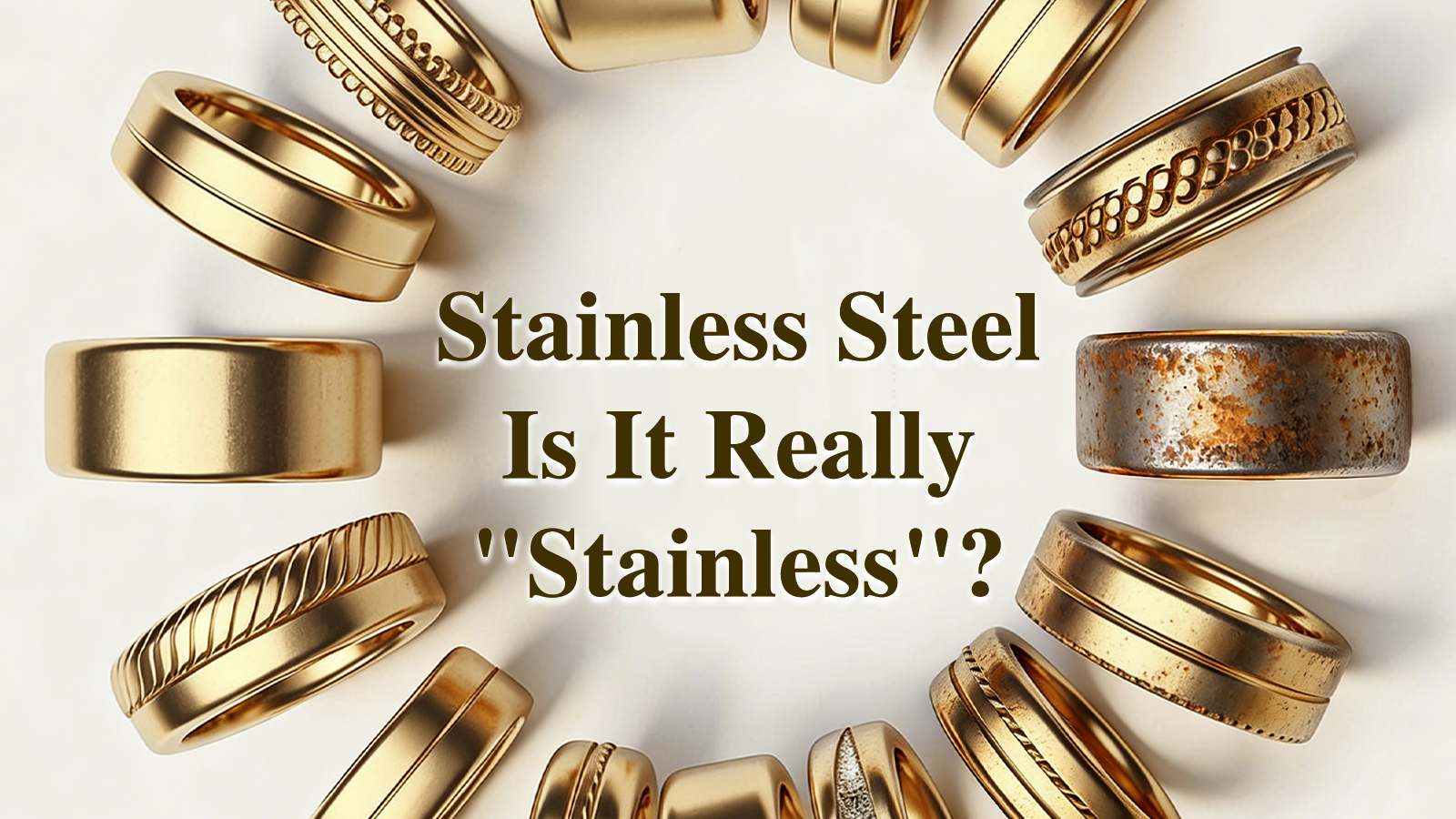
In the world of luxury, true value often lies in the unseen details.
Stainless steel, a seemingly rational material, actually embodies a romantic vision of “eternity”. Adorning wrists and necks, it endures the infiltration of sweat, the corrosion of air, and the polishing of time day after day. Its unwavering durability is not a matter of luck, but a result of precise data and rigorous craftsmanship.
Today, let’s explore the stories behind these numbers — about how stainless steel jewelry resists the erosion of time, and how we safeguard emotions with science.
Every piece of stainless steel jewelry is born with a gentle promise: I will always be here.
The confidence behind this promise comes from an invisible armor on its surface — the passive film. This protective layer composed of chromium oxide is only 1 to 3 nanometers thick, one fiftieth of the diameter of a human hair, yet tough enough to block most corrosive elements.
When oxygen touches the surface, chromium elements bond with it. Stainless steel must contain more than 10.5% chromium to form a continuous and stable passive film. Our core materials, 316 and 316L stainless steel, have a chromium content of 16-18%, far exceeding this critical value. Even if the surface is scratched, the film can self-repair within minutes to hours as long as oxygen is present — this is the scientific truth of “rust-proof”.
However, just as there is no absolute eternity in the world, the protection of stainless steel needs to be understood and cherished.
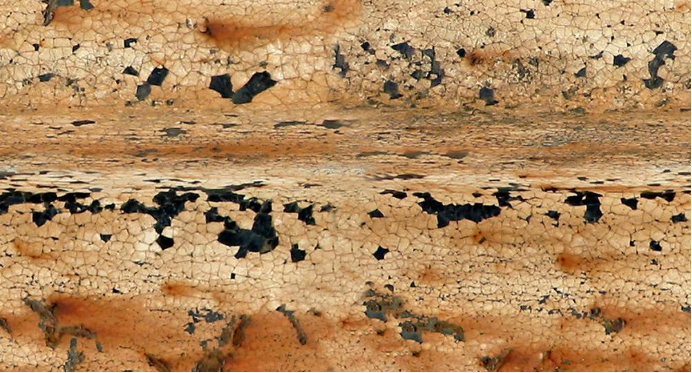
Have you ever noticed a tiny black spot suddenly appearing on a necklace you’ve worn for a long time? Like an ink stain on white paper, it is small yet striking.
This is not a betrayal of the material, but a chemical reaction known as pitting corrosion. The culprit is chloride ions (Cl⁻) in sweat, seawater, and humid air. These ions, with small radii and high activity, can penetrate the weak points of the passive film — such as inclusions, grain boundaries or micro-scratches in the material — and trigger local dissolution.
Once the passive film is broken, the exposed metal matrix and the intact surrounding film form a “small anode – large cathode” galvanic corrosion. The pH value inside the pit drops rapidly to 2-3 (equivalent to the acidity of citric acid), chloride ions continue to accumulate, and the corrosion rate rises exponentially.
Data speaks for itself: In an environment containing 0.1% chloride ions (equivalent to mild sweat), the pitting potential of 304 stainless steel is about 300mV, while that of 316L can reach more than 500mV. The Pitting Resistance Equivalent Number (PREN) is an internationally accepted evaluation index:PREN = %Cr + 3.3×%Mo + 16×%NThe PREN of 304 is about 18-20, while that of 316L reaches 24-28, an increase of more than 30%.
The extra molybdenum element is the reason why 316 and 316L remain unharmed even in sweat and sea breeze.
There is another more subtle change.
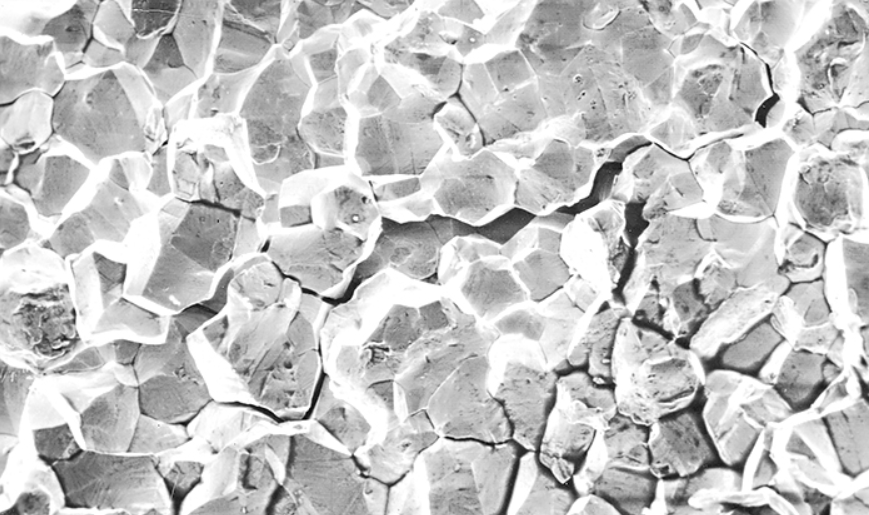
Intergranular corrosion sometimes occurs at the welding points and connecting rings of jewelry — the places that need the most structural strength. It does not show on the surface, but spreads quietly between crystal grains, just like the invisible estrangement between people, gradually weakening the originally firm connections.
This is usually related to the welding process. When stainless steel is heated to the “sensitization temperature range” of 450℃-850℃ (such as the weld heat-affected zone), carbon (C) at the grain boundaries combines with chromium (Cr) to precipitate chromium carbide (Cr₂₃C₆). Since the diffusion speed of carbon is much faster than that of chromium, chromium near the grain boundaries cannot be replenished in time, forming a “chromium-depleted zone” — the chromium content may drop below 10.5%, losing the passivation ability.
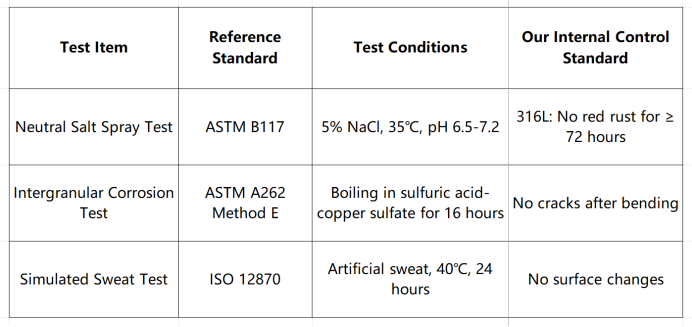
Data speaks for itself: The upper limit of carbon content in ordinary 304 stainless steel is 0.08%, while that of 316L is controlled below 0.03%, reducing the risk of carbide precipitation by more than 60%. In the ASTM A262 intergranular corrosion test, sensitized 304 samples usually develop cracks within 16 hours, while 316L can withstand more than 24 hours without obvious changes. The width of the heat-affected zone of laser welding can be controlled within 0.5mm, only 1/5 to 1/10 of traditional welding, and the material’s residence time in the sensitization temperature zone is shortened to the millisecond level.
When a piece of jewelry suddenly breaks on an ordinary morning, it is often not an accident, but a long-planned end. Intergranular corrosion takes away not luster, but inherent toughness.
Understanding the tests of time allows us to respond with greater care. As creators of jewelry, we build a quality moat for each piece with a series of data, and all of this is based on our core selection and rigorous processing of 316 and 316L stainless steel.
Every batch of products with 316 and 316L as the core materials undergoes strict testing to ensure that every piece delivered to you can stand the test of time.
After all this, what we really want to say is: Eternity is not a given, but a joint choice.
We choose better materials, more elaborate craftsmanship, and more stringent inspections; while wearers choose gentle care, regular maintenance, and understanding — understanding that every piece of jewelry will leave its own traces with the passage of time.
The beauty of stainless steel lies in its quiet perseverance in every detail without deliberate display. It can accompany a person for many years, witness countless important moments, and remain unchanged in shape and color forever.
If you are reading these words, you probably believe, like us, that objects can carry emotions, and that good materials deserve to be treated with care.
We are not just making jewelry, but forging containers for time. We welcome you to explore more details about materials, craftsmanship and design with us. Because when it comes to eternity, we always have endless stories to tell.