Welcome to Yibi Jewelry

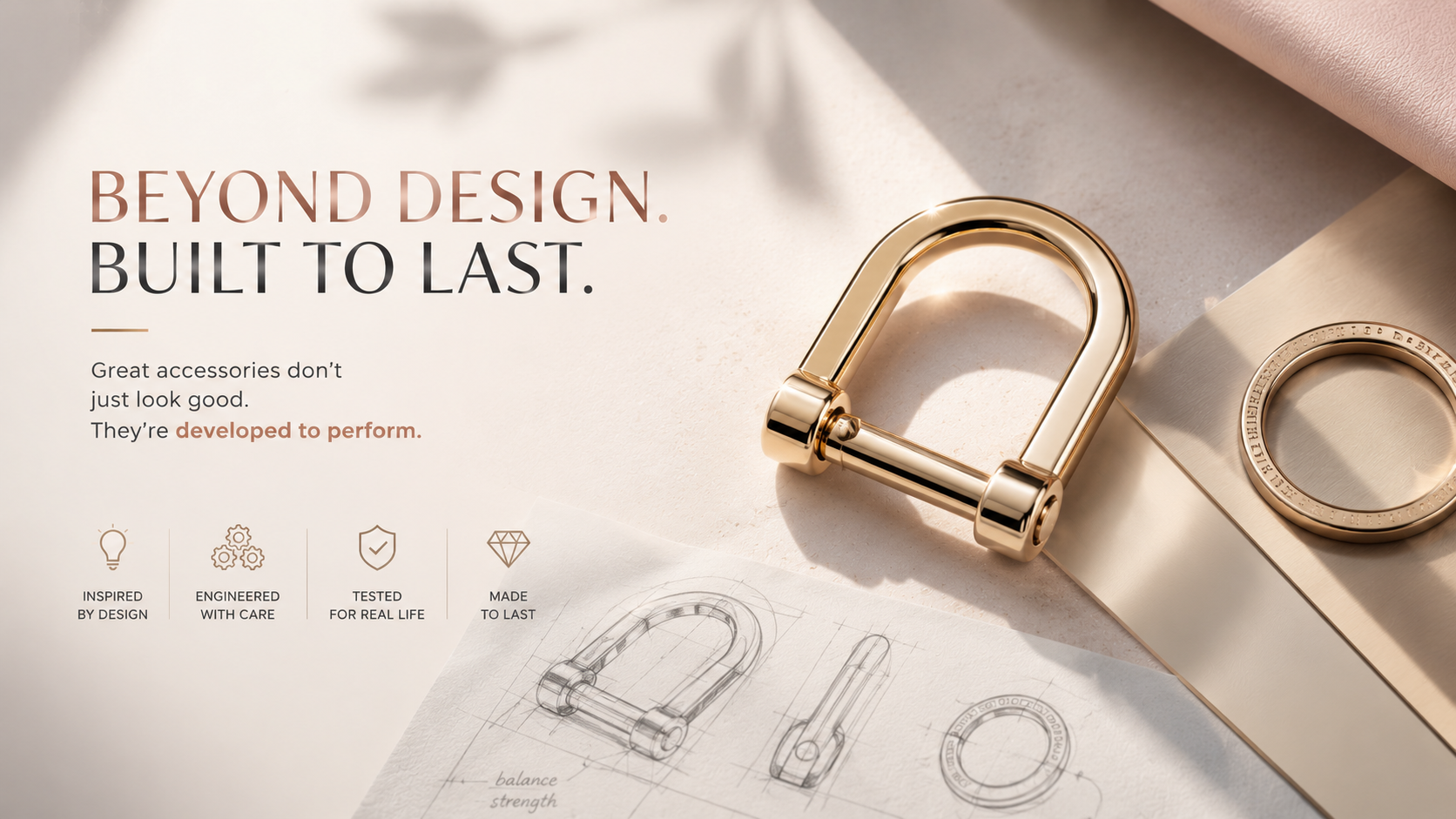
Good accessories are not just designed. They are engineered.
In the stainless steel jewelry and leather goods hardware industry, there is a common misconception:
Many brands think product development simply means turning a design drawing into a physical product.
But in real mass production, that is only the first step.
A drawing can define the shape, proportions, and visual language of a product. But it cannot automatically solve issues such as material density, structural strength, polishing routes, PVD adhesion, assembly tolerance, opening-and-closing durability, cost control, or batch-to-batch consistency.
That is why many problems that appear during sampling or production are not really “factory mistakes.” More often, they are the result of insufficient engineering validation during the design-to-product conversion stage.
In stainless steel accessories, a good product does not move directly from sketch to shelf.
It must go through material evaluation, structural optimization, process matching, sample validation, and production parameter refinement.
This is why we believe the real competitiveness of stainless steel accessories does not come from design alone.
It comes from development capability.
Stainless steel has a very clear characteristic: it is stable, but also very honest.
Unlike some softer materials, stainless steel will not hide structural problems through flexibility, wrapping, or surface finishing. Any detail that has not been fully considered at the design stage will eventually be exposed during sampling or mass production.
For example, a line may look beautifully slim in a drawing. But if the wall thickness is insufficient, the final product may deform during polishing, assembly, or long-term use.
A design may look sharp and minimal in 3D rendering. But if polishing access, inner corner radius, and surface treatment blind spots are not considered in advance, it will be difficult to achieve a stable finish.
A clasp may look clean and elegant on screen. But if the elastic structure, tolerance range, and repeated opening-and-closing performance are not validated early, the product may become loose, stiff, noisy, or even fail in real use.
A PVD color may look perfect on one sample. But if the base material condition, pretreatment, jig design, current distribution, coating thickness, and batch stability are not evaluated together, mass production may easily result in color differences, peeling, oxidation, or uneven surfaces.
This is the real challenge of stainless steel product development:
It is not enough to make one design “work.”
You have to prove that it can be reproduced consistently.
In real projects, the issues brands face are rarely caused by one single process.
More often, they come from a lack of alignment between design, material, structure, and manufacturing process.
If a product is too heavy, it may not only be a material issue. The structure may not have been optimized for weight reduction.
If a product is too thin, it may not only be a machining issue. The wall thickness may not meet the required strength.
If the polishing result is unstable, it may not only be a workmanship issue. The shape itself may not allow a reasonable polishing path.
If the PVD color is inconsistent, it may not only be a coating issue. Pretreatment, jig design, and product geometry may all affect film deposition.
If the assembly feels loose, it may not only be an assembly issue. The tolerance chain may not have been properly calculated and validated during development.
If the cost exceeds expectations, it may not simply be a pricing issue. The original design may have chosen a structure that is too difficult or inefficient to manufacture.
Therefore, a mature stainless steel ODM supplier should not simply wait for drawings, quote, open molds, and make samples.
Its real value lies in identifying potential risks before the product enters high-cost stages.
Where will the yield be affected?
Where will cost increase?
Where will the structure become unstable?
Where will mass production consistency become difficult?
This is DFM — Design for Manufacturing.
For stainless steel accessories, DFM is not a procedural formality.
It is one of the key factors that determines whether a product can enter mass production successfully.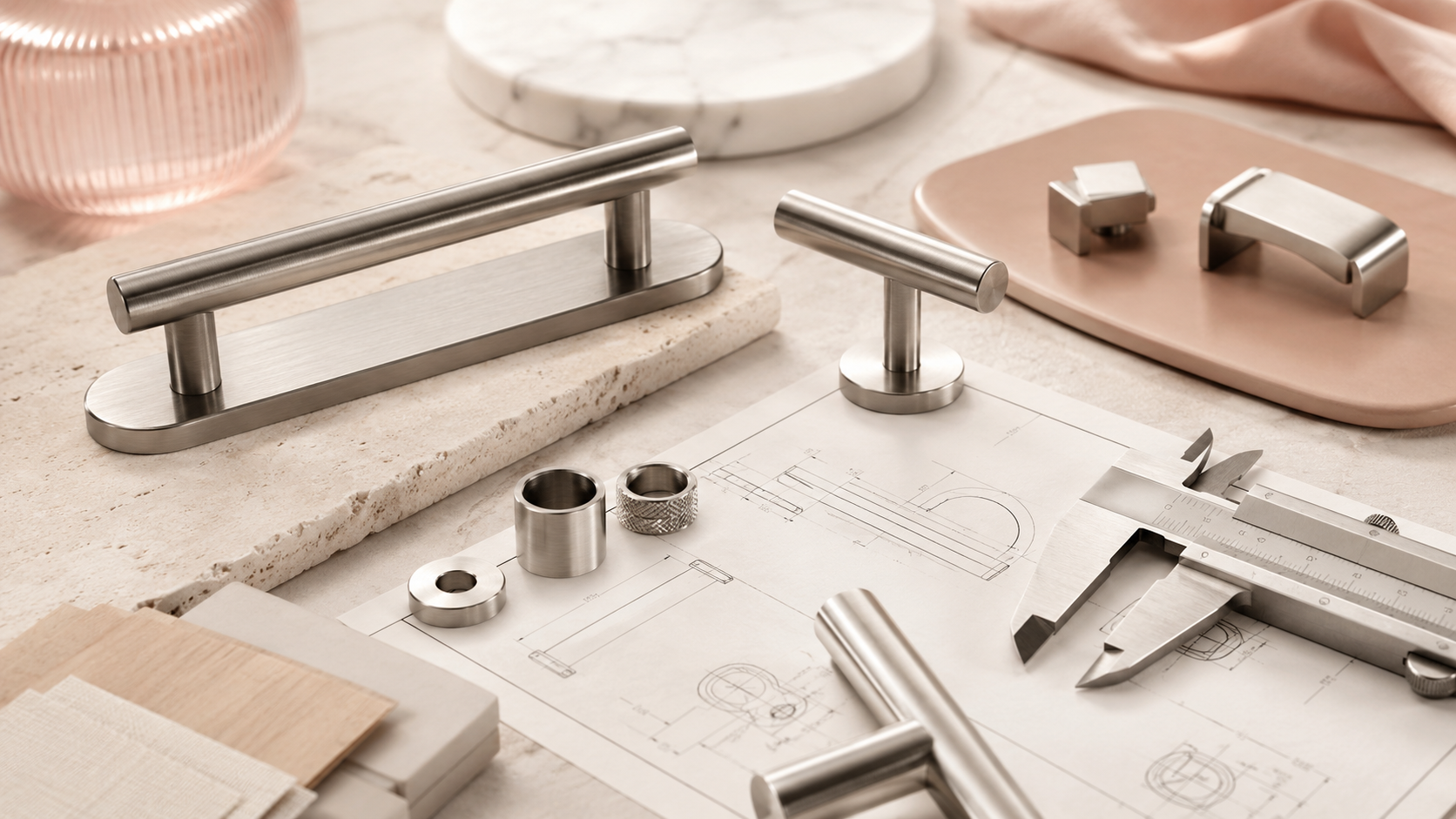
Many brands worry that structural suggestions from suppliers may compromise the original design.
But professional development is not about making a design look more ordinary.
It is about making the product more stable without damaging the design language.
This requires several types of judgment.
First, material judgment.
304, 316L, and other special stainless steel grades are not simply about which one is “better.” The right choice depends on the product’s application.
Jewelry requires long-term wearability, skin contact safety, corrosion resistance, and surface quality.
Leather goods hardware requires structural strength, wear resistance, opening-and-closing durability, and stable interaction with leather.
If the material is wrong, later processes can hardly compensate for it.
Second, structural judgment.
Wall thickness, stress points, connection methods, corner radius, hollow-out ratio, closure structure, and assembly sequence all affect whether a product can be formed, finished, assembled, and used reliably.
A tiny radius adjustment may reduce polishing dead zones.
A hidden internal support structure may improve strength without visually increasing thickness.
Third, process judgment.
The same design can sometimes be made through stamping, CNC, MIM, casting, welding, or a combination of several processes.
But each route has a different impact on cost, precision, surface quality, and production efficiency.
A mature ODM supplier does not only answer, “Can we make it?”
It should answer, “Which method will make it most stable?”
Fourth, production judgment.
A beautiful sample does not mean stable mass production.
Real development must verify whether the product can remain consistent across 100, 1,000, or 10,000 pieces.
Can the yield be controlled?
Is the rework rate acceptable?
Is the surface finish stable?
Is the assembly process efficient?
Can the product pass testing standards?
Only when these questions are answered does a design truly become ready for launch.
From a brand perspective, design represents aesthetic direction.
From a manufacturing perspective, development determines whether the product can truly exist.
Good development is not about simply telling the brand, “This cannot be done.”
It is about offering a more mature solution.
How can we keep the original proportions while reducing weight?
How can we maintain a minimal appearance while improving structural strength?
How can we make edges safer without losing sharpness?
How can we achieve the target PVD color while improving batch consistency?
How can we make the clasp feel more premium while ensuring repeated-use durability?
How can we reduce mold modification and rework costs without changing the design language?
This is where development capability creates real value.
It does not compromise design.
It turns a visual concept into a deliverable product.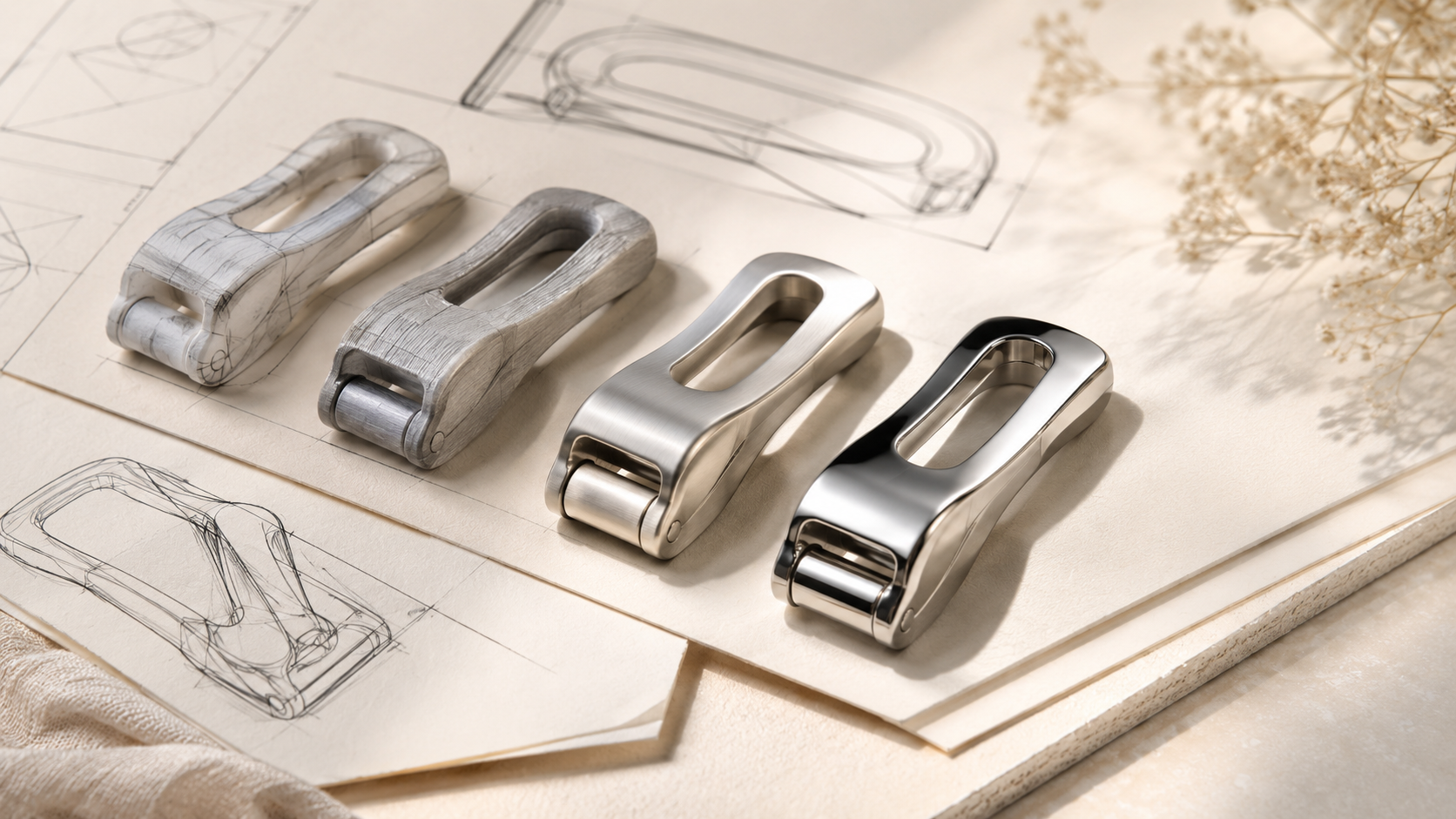
We once worked on a stainless steel bracelet project.
The original design was very minimal, with clean lines and a premium visual effect. But once sampling began, several issues quickly appeared.
The original wall thickness was too thin, making the product prone to deformation during polishing.
The closure structure required extremely tight dimensional accuracy, which made assembly stability difficult to control.
The gradual section change caused uneven current distribution during PVD processing, leading to visible color inconsistency on the surface.
If the project had continued according to the original drawing, mass production would likely have required repeated mold modifications, higher rework costs, lower yield, and possible delivery delays.
Instead, the engineering team optimized the product in four areas without changing its overall visual language:
Key wall thickness was adjusted to improve structural stability.
A hidden internal support structure was added to reduce deformation risk.
The closure mechanism was optimized to improve assembly reliability.
The PVD jig and processing route were redesigned to improve surface consistency.
In the end, the product kept its original minimal aesthetic while achieving better structural strength, assembly efficiency, and surface stability.
This case proves one thing:
Real development does not make design more complicated.
It makes design more reliable.
In the accessories industry, brands certainly need strong design.
But what truly determines whether a product can be successfully launched is often not the drawing itself.
It is whether that design can be quickly, stably, and controllably transformed into a product.
The most competitive brands in the future may not be the ones with the most design ideas.
They will be the ones that can continuously turn creativity into products that can be manufactured, delivered, and purchased repeatedly.
Behind this capability, brands need more than supplier capacity.
They need more than a simple quotation.
They need suppliers who understand materials, structures, process routes, production validation, and real consumer usage scenarios.
Good stainless steel accessories are not simply drawn.
They are validated, refined, and engineered through material, structure, process, testing, and mass production.
Design gives a product its form.
Development gives it the ability to exist in the real world.