Welcome to Yibi Jewelry

Many jewellery brands already understand the advantages of 316L stainless steel.
It offers strong wear resistance, good water resistance and, when combined with PVD, long-lasting colour performance. It can also reduce dependence on traditional brass, silver and precious-metal plating systems.
Yet when it comes to product development, many brands still hesitate to make the switch.
One major reason is design flexibility.
For years, stainless steel has often been associated with simpler designs and limited stone-setting possibilities, especially when it comes to pavé, small stones and high stone coverage.
Compared with brass or silver, stainless steel is harder and leaves much less room for adjustment during machining and setting. The denser the stone layout, the greater the demands on seat geometry, machining precision, remaining metal structure and setting stability.
So even as brass, silver and plating costs continue to rise, many brands have stayed with their existing material systems.
Because changing material should not mean compromising the design.
This is exactly the challenge YIBI has been working to solve.
Building on our experience in MIM, YIBI has carried out a series of secondary developments across material behaviour, mould design, stone-seat structure and downstream processing.
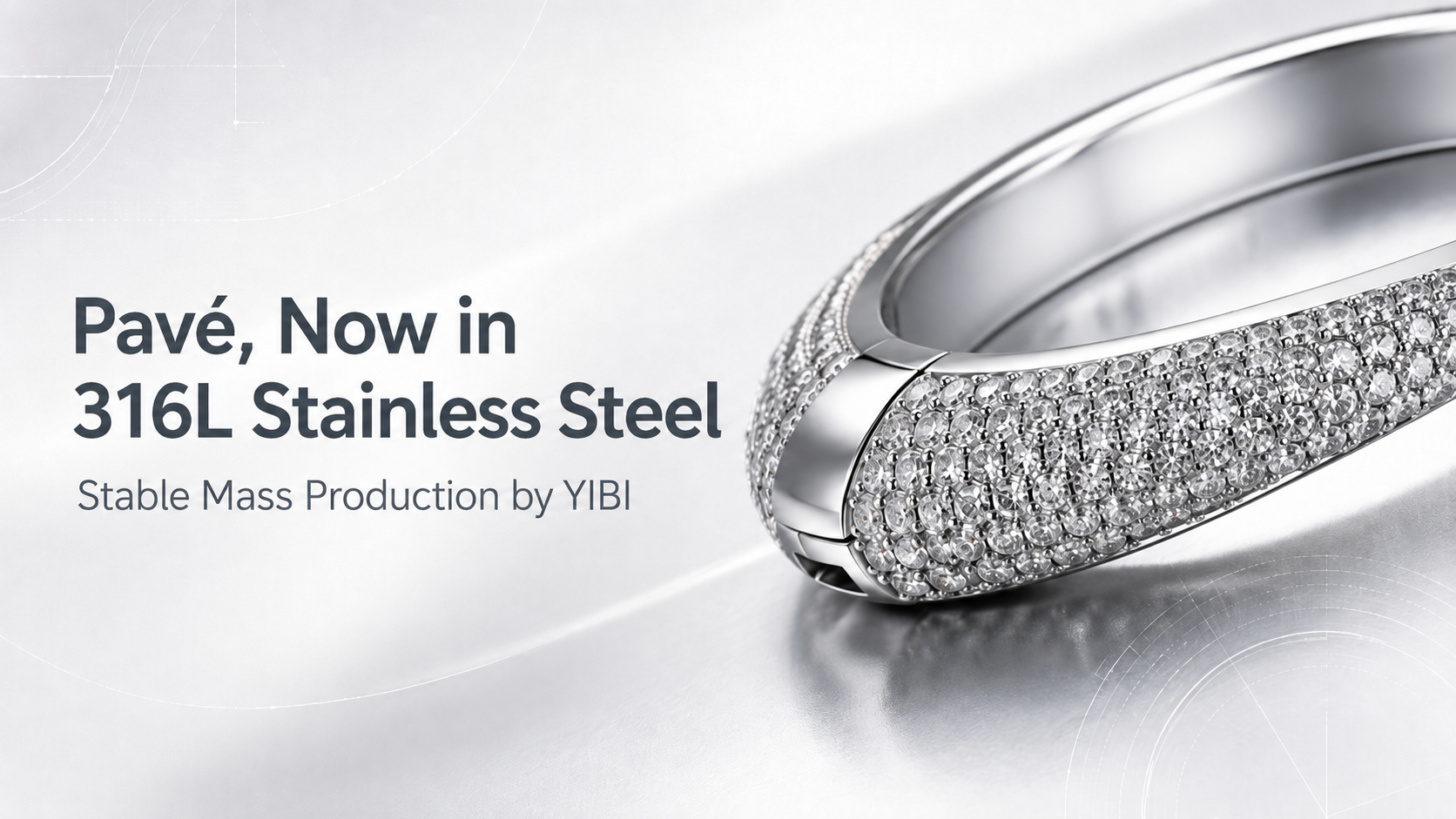
Today, we have achieved stable mass production of high-density pavé structures in 316L stainless steel.
This means that some designs previously more dependent on brass or silver can now be developed and produced at scale in stainless steel.
For brands looking to transition from brass or silver, stone-setting design no longer has to be the barrier.
With a 316L stainless steel + PVD solution, brands can retain dense pavé, high stone coverage and more complex design language, while gaining the durability, colour stability, cost structure and production efficiency advantages of stainless steel.
The real breakthrough is not simply making pavé possible in stainless steel.
It is giving brands the freedom to choose stainless steel without having to choose between design and material performance.